
What helps you find your voice, works more than 20,000 times a day, and is roughly the size of a dinner plate? Meet your diaphragm. This extraordinary muscle is essential to breathing, powers us to speak, and even plays a role in how our bodies respond to stress.
As the diaphragm works automatically, most of us rarely give it a second thought. But here's what makes it fascinating: It's one of the few skeletal muscles we can also consciously control. That makes it a remarkable bridge between the body’s involuntary functions and intentional practices like deep breathing, singing, and speaking.
“It’s the most important muscle in the body in my opinion,” says Deena Noroian, executive voice coach, founder of Voice Up, and author of Loud: The Voice That Cures Everything. “A lot of people think that the lungs are what we breathe with, but they are just inert sacks. The diaphragm does the breathing.”
Beyond the essential act of breathing, a skill Noroian says many of us could stand to sharpen, the diaphragm may also hold the key to unlocking our truest selves. Learning to use it effectively can transform how we communicate, giving us greater command of our voices, more confidence in our presence, and even a stronger sense of self.
So, when was the last time you gave your diaphragm some thought? Here’s our impassioned argument for why this muscle deserves more attention, how to recognize when yours could use some love, and three simple exercises to help it perform at its best.

Understanding the Diaphragm
First, let’s dive into the anatomy. Your diaphragm is a large, dome-shaped muscle that sits just below your lungs, separating your chest cavity from your abdomen. It’s thinner than you might think, only about one-quarter-inch thick and is about the size of a dinner plate in circumference.
“It looks like an upside down umbrella, cutting the thoracic cavity in half,” explains Noroian. “The diaphragm’s first order of business is your breathing muscle. You cannot take a breath without it.”
Every time you inhale, your diaphragm contracts and moves downward, creating a vacuum that compels your lungs to expand and draw in air. As you exhale, it relaxes and rises back into its dome shape, helping push air out. This simple movement happens about 20,000 times a day, both automatically and under our conscious control, allowing us to speak or sing as air passes through the vocal folds, which vibrate to create sound.
The diaphragm's responsibilities extend well beyond moving air. It works with the abdominal and pelvic floor muscles to support posture and core stability. Its rhythmic movement also helps with circulation and the return of blood and lymphatic fluid.
There's another fascinating connection: The vagus nerve, which plays an important role in the body's parasympathetic nervous system, passes through an opening in the diaphragm. Slow, controlled diaphragmatic breathing can help encourage the body's relaxation response, making this muscle an important player in how we manage stress.

How Can I Find It?
For such an essential muscle, the diaphragm can be surprisingly difficult to locate. Unlike your biceps or quads, you can’t easily flex your diaphragm in a way you can easily see in the mirror or even feel in your body. Much of its movement happens out of sight, beneath your rib cage—and it has very few pain or touch receptors, making it tricky to sense.
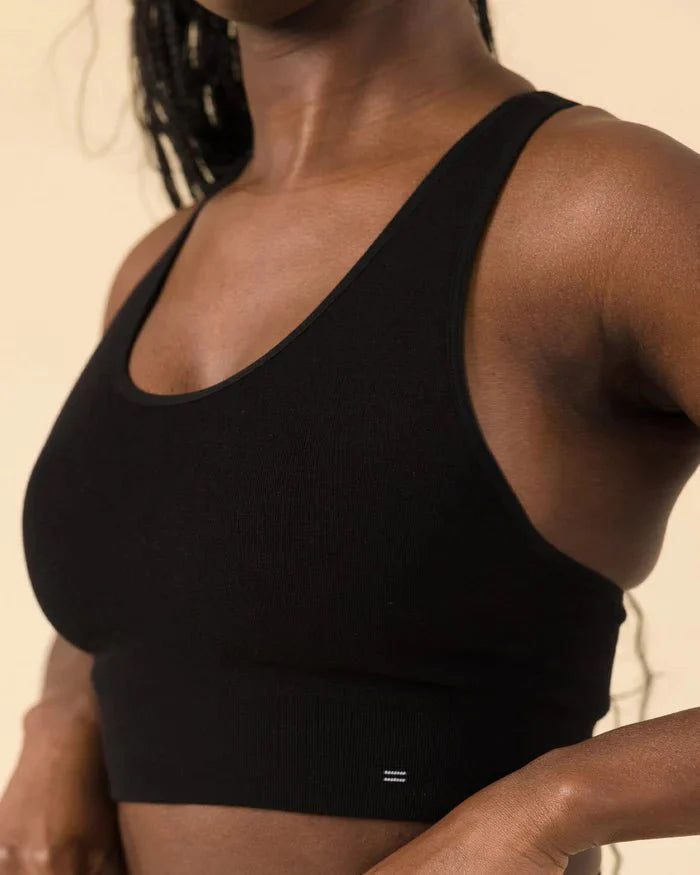
In order to feel your diaphragm, Noroian recommends placing your hand or fingers below your sternum (right in the center of your body, under your chest where the band of your beloved Bralette or Busty Bra would go). Take a breath in and this area should push forward slightly. That’s your diaphragm.
Signs of a Diaphragm in Distress
Your diaphragm is in constant motion, but similar to the pelvic floor, it can be weak without us even realizing it. Noroian sees this often, in part because many of us have been taught that breathing looks like lifting up” “I say this a million times a day: ‘Inhale is down.’”
Take a moment to observe yourself in the mirror. As you inhale, do your shoulders rise toward your ears? Does your upper chest lift dramatically? Do you feel tension in your neck? These movements can indicate that you're relying heavily on accessory breathing muscles rather than allowing your diaphragm to handle most of the work.
Noroian also says you can hear if your diaphragm is working optimally or not. If you struggle to project your voice, feel like you're speaking from your throat, or frequently run out of air mid-sentence, your breathing mechanics might need attention. Without well-coordinated breath support, we may compensate by tightening muscles in the throat, neck, or jaw, potentially making vocal expression feel more effortful.
Noroian also points to the diaphragm’s relationship with other bodily functions, including digestion. The muscle surrounds the opening where the esophagus passes into the abdomen and contributes to the mechanism that helps prevent stomach acid from flowing backward. A weak diaphragm can lead to issues like acid reflux or indigestion.

The Diaphragm-Self Expression Connection
Here’s where things get especially interesting. The diaphragm can play a fundamental role in how you express yourself, communicate with others, and make yourself heard.
“The voice is not just physical," Noroian explains. “It’s communicative. It’s intrinsic. It’s artistic. It’s expressive. It's the voice of an individual. It's what makes me me.” The ability to use our voices freely is intimately connected to our confidence and sense of self. After all, it’s how many of us advocate for ourselves, express our needs, or share our ideas. “If we hold back that physical voice, it's very hard to feel confident in our emotional expressive voice," she says.
For women in particular, the challenge often begins in childhood. “Our society trains women to be quiet. We train girls to be sweet and demure,” she says. “[From a young age, girls learn that] loud is obnoxious, loud is unattractive.” A landmark 1990 survey by the American Association of University Women found that girls experience a significant drop in self-esteem and academic confidence as they enter adolescence, a finding that helped inspire Peggy Orenstein’s book Schoolgirls: Young Women, Self-Esteem, and the Confidence Gap. For many girls, growing up means becoming increasingly hesitant to speak up, assert themselves, and make their voices heard.
This judgment can continue into adulthood. One study out of Yale in 2014 looked at vocalization in the workplace. Participants read about a hypothetical CEO and rated how competent he or she was. Male CEOs who spoke more than their peers got 10% higher competence ratings. Female CEOs who did the same got 14% lower ratings, from both men and women.
In her coaching practice, Noroian frequently encounters women who are uncomfortable projecting, even when they're simply speaking at a healthy, supported volume. “I often hear: ‘But I'm just yelling,’" she says. “No, you're projecting. You're using your body the way it's built to be used. Let me hear your whole person. Who’s in there? Let me hear all of it.”
Helping women—or anyone—rediscover that vocal power can be surprisingly emotional. Noroian describes clients who find themselves in tears after truly exercising their voice. After practice and getting comfortable with the feeling and sound, she says many feel more “confident, regulated, and calm.”

How to Strengthen Your Diaphragm
Some good news: It’s relatively simple to strengthen your diaphragm. In fact, Noroian says some of the most effective exercises involve things you're already doing every day: breathing and making sounds.
Her biggest piece of advice is to focus on how your diaphragm moves. Remember, the muscle contracts downward when you inhale. Your shoulders and neck should remain relaxed, while your lower rib cage gently expands. As you perform these exercises, it might be worthwhile to consider what you’re wearing. One benefit of seamless Merino: the bra band will stretch and flex with your body, so that the area around your diaphragm can move freely without restriction.
Here are three exercises Norian recommends:
1. The Pressure Hiss
Lie on the floor with something on your chest, right below the sternum. Keeping your chest, neck, and shoulders down, slowly exhale while making a sustained "ssss" sound. Try to maintain a sense of expansion around your lower ribs as the air flows out. Work up to a 30-second hiss.
2. The Lip Trill
Remember making motorboat sounds with your lips as a kid? That’s what a vocal coach would call a “lip trill.” Take a comfortable breath through your nose, then exhale through loosely closed lips, allowing them to flutter together in a continuous “brrrr” sound. If lip trills feel difficult, then tongue trills work too.
3. Sing It Out
“The best most ergonomic natural way that we can strengthen our diaphragm is singing,” says Noroian. Plus, it just feels good.
Choose a song you love and sing at a comfortable, full voice. Don't worry about how you sound. This exercise is about exploring your voice. Noroian is a serious proponent of the idea that everyone can—and should!—sing.
“That there's no secret to it. Everybody has the exact same instrument,” she says. “If you can talk, you’re already singing. The only difference is sustaining a note. Music comes in and activates a completely different and magical part of your brain that is extraordinarily healthy.”
So we want to know—do you think about your diaphragm? What’s your relationship to your own voice? We always love to hear and to learn from you. Please get in touch anytime at info@branwyn.com or on Instagram @branwynofficial.